01
Detect
Sensors identify approaching pedestrians and/or vehicles.

Controlled pedestrian and vehicle crossings using detection, warning signals, projected guidance, gates, barrier arms and coordinated operating logic.
Best fit: Pedestrian routes that cross forklift or vehicle travel lanes.
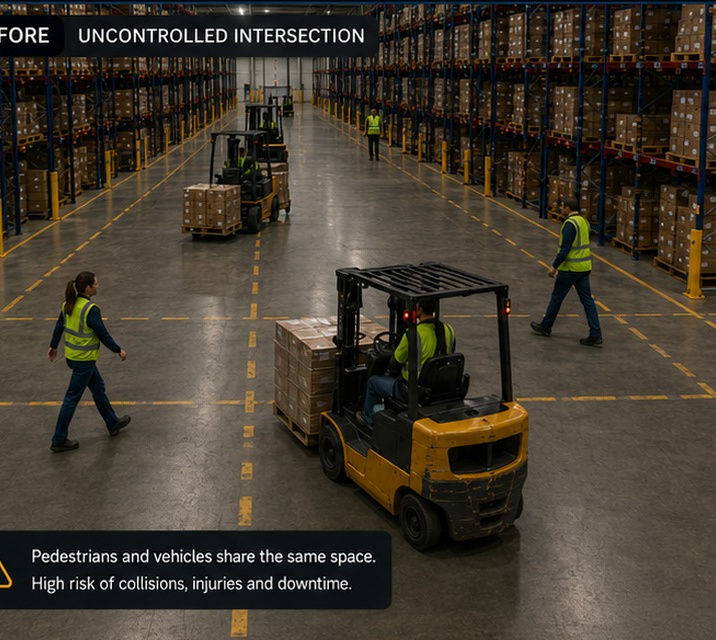
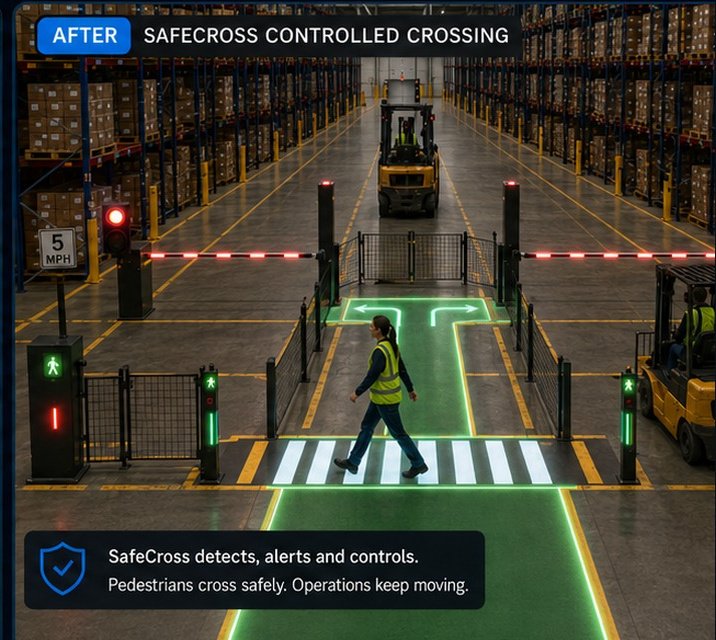
Controlled pedestrian and vehicle crossings using detection, warning signals, projected guidance, gates, barrier arms and coordinated operating logic.
The exact sequence is configured for the application, but the system logic commonly follows this pattern.
Sensors identify approaching pedestrians and/or vehicles.
The controller evaluates occupancy and determines which movement has right-of-way.
Signals, gates, barrier arms and/or projected warnings communicate and control movement.
Once the conflict area clears, the crossing returns to its normal operating state.
The final bill of materials depends on the site, but these are common components in this solution family.
Crossing width, vehicle speed, stopping distance, pedestrian flow, emergency egress, traffic direction and the desired fail-state should all be considered before selecting the final sequence.
The final design depends on traffic, visibility, equipment and operating logic, but these are common application types.
Forklift aisles crossing pedestrian routes
High-traffic warehouse intersections
Dock-area pedestrian crossings
Manufacturing traffic conflicts
Controlled entry into vehicle lanes
Many applications combine more than one SOS solution family.
A crossing, blind spot, dock, traffic control or mobile equipment problem may use more than one SOS solution family. SOS can help evaluate the application before you choose the technology.
Share the traffic pattern, facility area or operating challenge and SOS can help evaluate the right combination of technology and controls.